Shibarium bridge - Token Routes and Arrival Verification
Updated:
Shibarium bridge transfers eligible assets between Ethereum and Shibarium using token-specific PoS or Plasma bridge contracts. Choosing a route starts with the asset’s contract mapping, direction, and supported format. Deposits create a pegged representation on Shibarium, while withdrawals burn that representation before an Ethereum exit releases the counterpart. A source transaction hash identifies one transaction; matching destination credits and the recipient’s balance or token ownership establish arrival. Route availability, gas requirements, and processing time can change independently, so the selected asset and direction govern the transfer.
Asset Mapping Before Route Selection
Token compatibility determines which bridge mechanism can handle a transfer before withdrawal speed becomes a useful comparison. Proof-of-stake (PoS) bridge support covers ETH and the ERC-20, ERC-721, and ERC-1155 token standards. That coverage describes supported formats. An individual token or collection also needs the relevant mapping and an enabled route for the requested direction, because format compatibility alone doesn’t establish a connection between its contracts on Ethereum and Shibarium.
Plasma uses its own mapped assets and Ethereum exit contracts. Plasma’s general compatibility list covers ETH, ERC-20, and ERC-721, and excludes ERC-1155. The withdrawal instructions distinguish Plasma (BONE) from PoS token options. A listed format doesn’t guarantee an enabled route for a particular asset. Custom integrations using Chainlink’s Cross-Chain Interoperability Protocol (CCIP) form another implementation option. CCIP must support the network pair and token route, and the deployed contracts must support the transfer; the possibility of building an integration doesn’t establish a live transfer service.
PoS Checkpoints and Plasma Exit Contracts
PoS and Plasma connect source-chain activity to Ethereum through different validation mechanisms, which affect how a withdrawal progresses.
PoS Checkpoints
Validators create checkpoints that record Shibarium chain data on Ethereum. A PoS withdrawal relies on inclusion of its source transaction in a checkpoint before Ethereum can process the corresponding exit. Fast block production on Shibarium doesn’t eliminate that dependency. The withdrawal’s Ethereum stage needs the relevant checkpoint proof, even after the source chain has confirmed the burn.
Plasma Exits
Plasma contracts use an Ethereum exit mechanism for assets assigned to that path. The source burn, exit proof, and Ethereum processing belong to one withdrawal, so its exit conditions determine progress even when the Shibarium receipt already reports success and the source balance reflects the burn. The documented Plasma mechanism combines exit-proof validation with fraud challenges and validator verification. An advertised duration alone doesn’t establish the strength of those checks.
Source Networks and Fee Balances
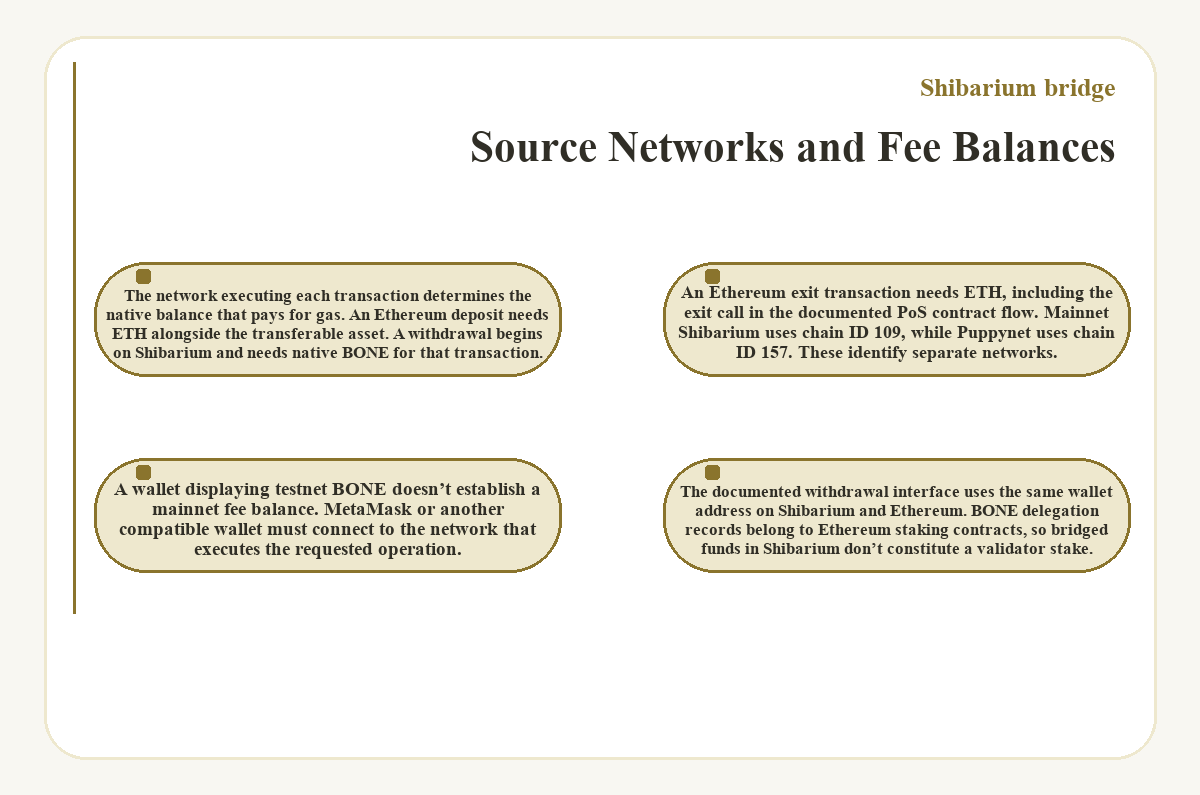
The network executing each transaction determines the native balance that pays for gas. An Ethereum deposit needs ETH alongside the transferable asset. A withdrawal begins on Shibarium and needs native BONE for that transaction. An Ethereum exit transaction needs ETH, including the exit call in the documented PoS contract flow.
Mainnet Shibarium uses chain ID 109, while Puppynet uses chain ID 157. These identify separate networks. A wallet displaying testnet BONE doesn’t establish a mainnet fee balance. MetaMask or another compatible wallet must connect to the network that executes the requested operation. The documented withdrawal interface uses the same wallet address on Shibarium and Ethereum. BONE delegation records belong to Ethereum staking contracts, so bridged funds in Shibarium don’t constitute a validator stake.
ERC-20 Approval and Transfer Commitment
ERC-20 authorization and the bridge transfer have different effects, even when an interface presents them within the same deposit flow.
Spending Allowance
ERC-20 approval gives a designated spender an allowance to move tokens from the owner’s balance. The spender address and approved amount define that permission. Check the token’s allowance for the owner and spender, because approve can return false without reverting the transaction. That permission doesn’t establish a bridge deposit or destination credit. An existing allowance can affect whether the interface requests another approval.
The Bridge Transaction
The transfer transaction invokes the selected bridge contract with the relevant asset and recipient details. Wallet connection alone doesn’t authorize that transfer. Signing authorizes the transaction, submission broadcasts it, and an execution receipt establishes what the source chain did. The contract address, encoded action, network, and amount deserve attention before signing, because a valid signature authorizes the specific transaction presented.
Deposits Through Ethereum State Sync
An Ethereum deposit locks eligible source assets and creates their pegged representation on Shibarium. The bridge’s deposit model uses a 1:1 token quantity relationship. That relationship concerns the transferred units; gas charges remain separate from the representation’s token amount.
State synchronization carries Ethereum events into Shibarium. Heimdall monitors the
StateSynced
event, and the receiving contract applies the associated data on the destination network. Bor executes the destination-side state changes. These components explain why successful Ethereum execution can precede the receiving balance update, without implying that a wallet must sign a separate transaction for every internal synchronization step.
Withdrawal Burns and Ethereum Exits
A withdrawal burns the bridged representation on Shibarium and unlocks its counterpart on Ethereum through the selected route’s exit mechanism.
Checkpoint-Based Withdrawal
The PoS contract flow waits for checkpoint inclusion before processing an exit through the
RootChainManager
. That contract verifies inclusion and decodes the relevant event logs. An authorized predicate contract applies the Ethereum state change. The source transaction hash identifies the burn that the proof concerns; it doesn’t itself replace the proof or confirm the recipient’s Ethereum balance.
Plasma Withdrawal
The Plasma path handles its assigned assets through Plasma exit contracts. Ethereum processing must complete before the recipient can treat the corresponding assets as received. Exact prompts and permitted tokens belong to the selected interface and mapping. A withdrawal instruction for one token’s Plasma path doesn’t establish that another token can use it.
Processing Time and Route Availability
Bridge timing follows the work that remains on each network, including source inclusion, state synchronization, checkpoint production, or Ethereum exit processing. Congestion and validator activity affect those stages. A fast source receipt can coexist with an incomplete cross-chain transfer. A displayed estimate describes the selected operation’s expected duration. It doesn’t turn elapsed time into an arrival record. Available token choices, transfer limits, and fee quotes can also change. A wallet connection establishes access to the interface, while acceptance of the particular asset and direction determines whether that interface can submit the requested transfer.
Transaction Receipts and Bridge Progress
A transaction receipt records execution on one chain, so bridge progress requires distinguishing the source operation from the destination operation. The
eth_getTransactionByHash
method identifies a transaction known to the queried node. The
eth_getTransactionReceipt
method returns its receipt after inclusion, when that node has one.
A pending transaction has no transaction receipt.
A receipt with
status
equal to
0x1
reports successful execution;
0x0
reports failure. The intended deposit or burn’s successful receipt and relevant event logs establish its source-chain result. Bridge event logs, checkpoint inclusion, and the applicable exit record connect that result to subsequent processing.
Arrival Evidence by Asset and Bridge Mechanism
Destination evidence must match the asset and mechanism that the source transaction actually used. For an eligible ERC-20 deposit from Ethereum, suppose its deposit receipt reports success and includes the bridge event, while the Shibarium wallet shows no incoming tokens. Query the intended recipient’s balance at the mapped token contract on Shibarium, and match any destination credit to this deposit’s state-sync record. A current balance alone can include earlier holdings.
| Transfer Option | Eligibility Condition | Arrival Evidence | Security Dependency |
|---|---|---|---|
| ETH Through PoS | Enabled ETH route | Shibarium representation credited on deposit; native ETH received after Ethereum exit | PoS bridge contracts and validator verification |
| ERC-20 Through PoS | Supported token mapping | Mapped token balance credited | PoS bridge contracts and validator verification |
| ERC-721 Through PoS | Supported collection and token ID | Destination token ownership | PoS bridge contracts and validator verification |
| ERC-1155 Through PoS | Supported contract, IDs, and quantities | Matching recipient credit and balances for those IDs | PoS bridge contracts and validator verification |
| Plasma-Mapped Asset | Asset assigned to an enabled Plasma route | Shibarium credit on deposit; Ethereum exit and recipient credit on withdrawal | Ethereum Plasma exit contracts |
| Custom CCIP Integration | CCIP supports the network pair and token route; integration is deployed | Recipient token credit verified under the integration’s delivery rules | Deployed custom contracts and CCIP implementation |
If the balance query used the wrong network or contract, correct those settings before repeating the query. If the corresponding destination credit exists and the mapped balance reflects it, the missing wallet display doesn’t require another deposit. If you can’t locate a matching destination credit, preserve the successful Ethereum transaction and investigate its state-sync processing. Repeating the source deposit would create another transfer request without resolving the existing transfer.
An outbound withdrawal presents a different comparison. A successful Shibarium burn with no completed Ethereum exit still lacks arrival evidence. The existing burn remains the reference for checkpoint or Plasma exit processing. The applicable Ethereum exit must succeed and credit the intended recipient with the corresponding asset; those records distinguish arrival from a burn that succeeded on Shibarium while Ethereum processing remains incomplete.
Destination Tokens and Wallet Display
Wallet visibility depends on the destination network and token contract, as well as the underlying balance. An ERC-20 balance can exist on-chain without appearing in the wallet’s token list. Importing the mapped destination contract can reveal that balance; importing a token doesn’t move funds. For ERC-20 tokens,
balanceOf
identifies the account balance, and the token’s decimal precision determines its readable quantity. The contract address belongs to that particular network. For an NFT transfer, ownership of the relevant collection’s token ID provides the appropriate destination evidence. ERC-1155 assets require matching the token IDs and their quantities. A ticker alone can’t distinguish different deployments.
Recovery Boundaries After a Transfer Failure
Recovery depends on whether the intended source transaction failed, remains pending, or succeeded and awaits destination processing. The source transaction’s state determines whether recovery concerns that transaction or later bridge processing. An absent destination balance alone doesn’t identify the failing stage or justify replacing a confirmed source transaction.
A pre-submission error can concern insufficient native gas funds, missing authorization, unsupported token mapping, or invalid call parameters. Correct the affected input before submitting. For an included failure, inspect the receipt and available error details; retry only after correcting the cause, such as an insufficient gas limit. An increased fee doesn’t repair incompatible token support or an incorrect contract call.
A low-fee pending transaction can require a replacement using the same nonce and higher fee settings that its transaction type supports. That mechanism concerns a transaction awaiting source inclusion. It doesn’t replace a successful bridge burn, and a new nonce represents another source transaction.
After successful source execution, unresolved state synchronization, checkpoint inclusion, or exit validation belongs to bridge processing. Preserve the transaction identifiers and route details when investigating that stage. A missing proof or mapping error needs resolution for the existing transfer. An incorrect event signature can prevent exit validation by
RootChainManager
.
Frequently asked questions about Shibarium bridge
Do Minimum Transfer Amounts Apply Equally to Every Bridge Asset?
Transfer limits belong to the selected asset and route, so a single minimum doesn’t cover every supported token format. Fungible-token limits concern amounts, while NFT eligibility also concerns ownership and valid token IDs. Any minimum or maximum that applies must match the exact operation that the interface accepts.
Is a 1:1 Bridge Ratio a Promise of Equal Market Value?
A 1:1 bridge ratio describes corresponding token quantities and doesn’t guarantee equal market prices. The deposit model creates the pegged quantity, and withdrawal reverses that representation. This accounting relationship doesn’t set a trading price, guarantee liquidity, or make the gas needed for either network part of the transferred token quantity.
Can an ERC-20 Allowance Remain After a Bridge Deposit?
An ERC-20 allowance can remain after a deposit if the spender hasn’t exhausted or otherwise changed it. The token’s allowance state determines the remaining permission. A completed transfer doesn’t establish that this value is zero. The standard’s approve function can overwrite the allowance, including setting it to zero.
What Happens If I Select PoS After Initiating a Plasma Withdrawal?
Selecting another route doesn’t establish completion of the existing Plasma withdrawal. Its source transaction belongs to the mechanism that accepted it and needs the corresponding exit processing. A new PoS selection supplies neither that exit’s completion record nor proof that its recipient received the assets on Ethereum.
Are Failed Ethereum Bridge Calls Free?
An included Ethereum bridge call can consume gas even when execution fails. Its fee pays for the computational work performed, while failure prevents the intended state changes from completing. A transaction rejected before block inclusion differs from an included failure. Receipt status and gas usage identify the relevant case.
Should a Bridged Token Have the Same Contract Address on Both Networks?
A valid mapping identifies the relevant contract on each network, and those addresses don’t have to match. Contracts belong to their own chain’s state. Destination verification therefore uses the mapped destination address, even when the token retains the same name and symbol as its Ethereum counterpart.
Can I Withdraw Directly to an Exchange Deposit Address?
The documented withdrawal flow uses the same wallet address on Shibarium and Ethereum. A direct exchange deposit requires the receiving service to support the exact destination network and asset, and the bridge interface must permit that recipient. A valid blockchain address alone doesn’t establish those conditions. Bridge completion and credit to an exchange’s internal account are separate outcomes with different receiving requirements.
Does the validator-staking Maintenance Notice Cover Bridge Withdrawals?
The April 23, 2026 maintenance notice concerns Shibarium Validator Staking and reports disruption beginning April 17. It advises against staking transactions until restoration. That feature-specific notice doesn’t establish the operational state of bridge deposits or withdrawals, which have their own contracts, processing stages, and availability conditions.